
“I never sought to ‘overcome,’ destroy or even disparage nature.” ~ Gabriele Münter
Gabriele Münter was an early German Expressionist painter who was born in 1877 and died in 1962, times that were both progressive and devastating for the European continent. As a German citizen, Münter was caught up in war’s destructive force and as a non-traditional female artist, she was a target. Münter took great care through both wars to hid away artworks during the first and second world wars; it is thanks to her in particular that the world still has many great works of Expressionism.
World War Two was particularly harsh on artists in Europe, the Nazi regime was known for their destructiveness. The National Socialist German Workers’ Party, precursor to what is now known as the Nazi Party, began their movement in 1920 and determined that modern-art movements were a manifestation of society’s degraded nature (Levi, 1998). The term ‘degenerate art’ was coined early on as a label for anything that wasn’t inherently classically German in nature.
Degenerate art encompassed nearly all of the modern art movements like Impressionism, Post-Impressionism, Fauvism, Cubism, Abstract, and Expressionism; anything that encouraged a freedom of emotional and spiritual interpretation was regarded as suspect (Levi, 1998). The years preceding the war were full of creative expression, artists in Germany exhibited their works in an attempt to move the culture forward; some people pushed back, however, and the Nazi movement gained momentum throughout the 1920’s alongside Münter’s exploration into Expressionism. By the early 1930’s Hitler had gained power as Chancellor of Germany, chipping away at other powers until becoming an autocratic dictator.
House searches became a terrifyingly normal occurrence during the Nazi government and anything that was considered outside of traditional German culture was taken and destroyed. Using culture as a tool for oppression, German citizens were forced to burn books, records, and artwork as a visible pledge to the purity of their hearts and minds (Levi, 1998). Considered a valid German citizen, Münter escaped the very worst of Nazi capabilities; but as a known female modern artist, she did not escape scrutiny.
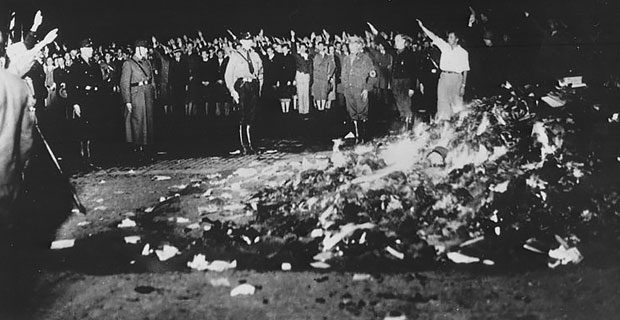
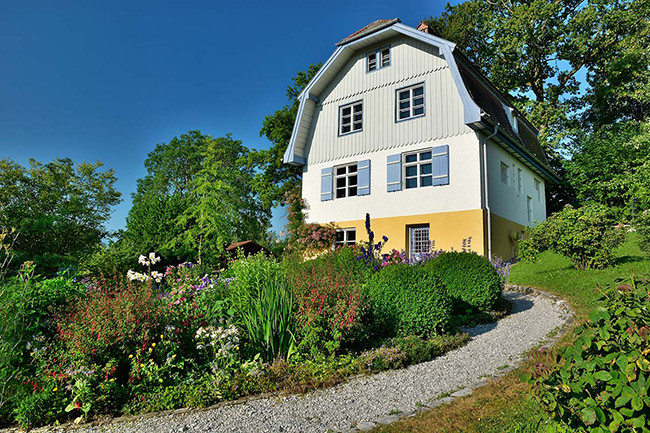
Münter was advised by her long term life-partner, Johannes Eichner, to paint scenes that would be more acceptable by Nazi standards, but Münter was unable to please them and in 1937 the public excoriated her current exhibition (P.W., 2013). Münter knew what was coming at this point; with Kandinsky’s works being declared degenerate art, her entire collection of expressionist paintings were in jeopardy of being seized by the government. At age sixty, Münter moved all of her art from Munich to her home in Murnau, Germany to keep it safe from the Nazis and the devastating effects of the war.
Life in Murnau did not end Münter’s interactions with the Nazi party. Multiple house searches were conducted in an effort to find and confiscate Münter’s art collection (Koerner von Gustorf, n.d.). The searches revealed nothing though, Münter’s extraordinary foresight led her to hide the works in the basement behind false walls (P.W., 2013). The great fear was that the paintings would be burned like so many thousands of great pieces under the Nazi regime, but curiously that was not always the case with pieces that were declared degenerate.
High ranking Nazis like Hermann Göring acquired pieces for personal use and in 1937 the Nazi party organized a Degenerate Art exhibition in Munich that saw more people attend than the neighboring exhibition of traditional German art (Levi, 1998). The Nazis sought to control the people by controlling the culture, but even their heavy handed scare tactics couldn’t seem to quell the interest in modern art; if anything, being verboten made it more compelling. Münter was right to hide her pieces though; even when they were not destroyed, many pieces were lost to their true owners forever through backchannel dealings and forged papers of provenance.
Münter’s quick thinking and marked determination in the end saved the thing she loved the most, her art. It is because of Gabriele Münter that great works from the early German Expressionist movement still exists; her dedication to art and its preservation ensures that everyone has an opportunity to study these paintings and gain insight into one of the greatest art movements of the twentieth century.
- Koerner von Gustorf, O. (n.d.). Profession: Woman Artist. Deutsche Bank Art Magazine. Retrieved from https://db-artmag.de/archiv/04/e/magazin-muenter.html
- Levi, N. (1998). Judge for Yourselves! The “Degenerate Art” Exhibition as Political Spectacle. The MIT Press, 85(Summer), 41-64. Retrieved from https://www.radford.edu/~rbarris/art491%20Museum/judge%20for%20yourselves.pdf
- P.W. (2013). This is the house we used to live in. The Economist. Retrieved from https://www.economist.com/prospero/2013/05/24/this-is-the-house-we-used-to-live-in

 Express Yourself: The Art of Gabriele Münter