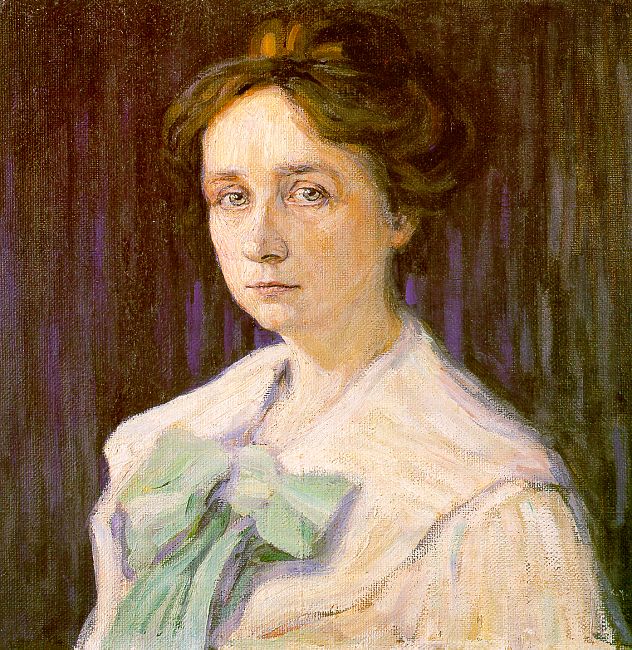
Gabriele Münter by Wassily Kandinsky, 1905 
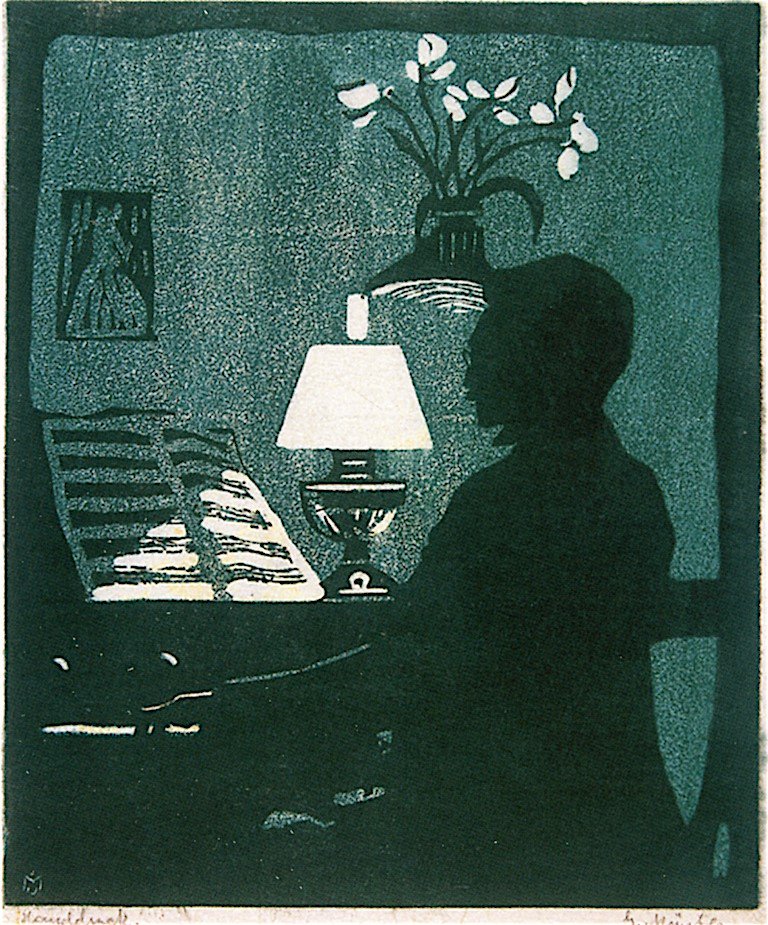
Wassily Kandinsky by Gabriele Münter, 1906
“In the eyes of many, I was only an unnecessary side-dish to Kandinsky. A woman standing alone…can never gain recognition through her own efforts, other ‘authorities’ have to stand up for her.” ~ Gabriele Münter
Readers of this blog’s earlier entries may be wondering; what about Kandinsky? Surely the Russian born artist was such an important part of Münter’s life that any mention of her should reference him enthusiastically. It is true that Münter and Kandinsky’s relationship profoundly affected both; the two great painters were associates, confidants, partners, and lovers. History is often written by those in power, however, and for much of history women have traditionally not held as much power as men; a result of this fallible design is that many important women have come to be defined by their relationships to men.
Whether by being lovers, mothers, or friends; artistic accomplishments especially are often attributed to the men with whom women associate. The observation is not meant to be a harsh criticism of gender or culture, merely a realization that the opportunity is there to create a different narrative; one that includes the contributions of women for their own accomplishments. The author is careful, therefore, to not sum up either artist’s abilities as a product of their relationship regardless of the strong influences. The placement of this entry is purposeful; Kandinsky was a powerful source of learning and development for Münter, but does not get to solely define who she was as an artist.
Münter and Kandinsky’s relationship was short in the grand scheme of life, twelve (ish) years, but the limited time did not lessen the immense impact the two painters had on one another; both were ultimately transformed by the way in which their relationship encouraged expressionist development. They met in 1902 when Münter enrolled at the ultra-modern art school Phalanx, of which Kandinsky was a founding member and teacher (wassillykandinsky.net). The Post-Impressionist style of art taught at the school was not the only thing that pushed the boundaries of what was expected the time, the school also admitted women; something not widely practiced by other academies. Münter would later say of this time with Kandinsky, “He understood, protected, and furthered [my] talent” (Bachrach, 1981).
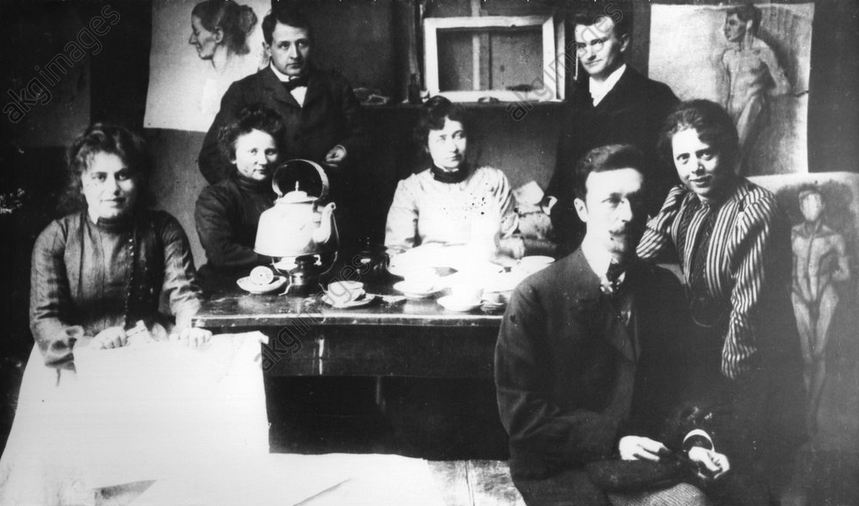
The teacher and student quickly developed a deep connection through their mutual appreciation of new art theories and soon began an intimate relationship. There was a problem however, Kandinsky was married. This fact would continue to plague the two artists as their relationship evolved along a natural continuum, but in the beginning they were consumed by the heady mix of emotional and physical attraction. The couple was content to sneak around the first couple of years; during one summer class stay in Bavaria, Münter departed in haste when Kandinsky’s wife Anja unexpectedly arrived (Koerner von Gustorf, n.d.). They kept this secrecy for a brief period and by 1904 Kandinsky separated from his wife to begin living with Münter full time.
The couple traveled over the next four years visiting places in North Africa and Europe, honing their abilities and experimenting with the artistic styles they encountered. Münter was especially taken with the art scene in Paris and spent much time analyzing the works of Matisse and Van Gogh; the influence of Fauvism with its bold colors and flat perspective is evident in many of her works after this point. Kandinsky and Münter shared a special connection over the use of color in their works, the powerful emotion in vibrantly colored scenes conveyed messages of inner thoughts and spirituality.
The two artists continued to grow their talent and interpretive styles over the time that they were together, often championing each other’s works. In 1911 Kandinsky’s Composition V was rejected for the New Artists’ Association of Munich, he and Münter promptly left the organization where he was the director in protest (Koerner von Gustorf, n.d.). Kandinsky and Münter soon became founding members of the Expressionist art group Der Blaue Reiter, The Blue Rider. It seemed to be that where one went, the other followed. Not all times were blissful however, and letters exchanged point at times to a feeling of unrequited love on Münter’s part (Koerner von Gustorf, n.d.).

The same genius that compelled the artists to one another was also at times a source for a passive rivalry born out of envy. Kandinsky was known to have written in a 1903 letter that the medium of woodcuts “might be much too much for the small, poor (lazy) Ella” (Smith, 1998). Petty arguments seemed to eat at the foundations of the relationship and despite having “engaged” themselves to each other early on; nothing ever came of the proposal; even in 1911 when Kandinsky was given a formal divorce from his first wife. Münter had bought a home for the couple in Murnau, Germany and the couple continued their tumultuous relationship for years until the start of World War I.
In 1914 Kandinsky could not remain in Germany. He was a Russian immigrant and with war looming on the horizon, he was considered an enemy alien in the country where he had lived and worked for over a decade. Münter and Kandinsky traveled quickly to Switzerland where they eventually parted ways, with Kandinsky returning to Moscow alone. Münter agonized over Kandinsky while they were apart and in the winter of 1915, reunited briefly in Scandinavia (P.W., 2013).
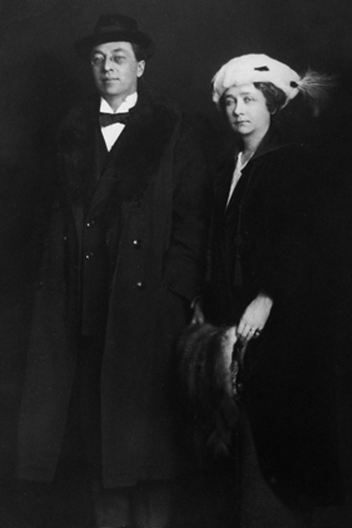
Kandinsky never officially broke things of with Münter, but his feelings expressed during their recent meeting were belied by his coming actions. Early in 1916, just months after meeting in Scandinavia, Kandinsky married his second wife in Russia; and it was not Gabriele Münter (Smith, 1998). She never saw him again.
Münter did not even find out about the marriage until five years later in 1921 when Kandinsky sent a lawyer to retrieve his paintings from before the war (Smith, 1998). Münter had faithfully and carefully preserved the art during the war and was incensed with the demand of their return. She sued for compensation due to his broken promises and ended up with over 1,000 of Kandinsky’s paintings when the case was settled in 1926, even though the majority of works had been reunited with their creator (P.W., 2013). Münter did not get past this heartbreak easily and painted very little for the next ten years.
Eventually Münter would find the joy in painting again and continued to personally develop her artistic style well into old age. There can be no doubt of the profound impact Münter and Kandinsky had on one another. They shared an excitement for painting that helped to ignite a passionate romance for over a decade. Their travels and times together exposed them to new concepts of the art world and provided encouragement to their experiments in expressionism. It would not be fair to sum up Münter’s talents to the teaching abilities of Kandinsky, but it would also be foolish to ignore the very real impact the artists had on each other
- Bachrach, S. P. (1981). A Comparison of the Early Landscapes of Munter and Kandinsky. Woman’s Art Journal, 2(Spring-Summer), 1st ser., 21-24.
- Koerner von Gustorf, O. (n.d.). Profession: Woman Artist. Deutsche Bank Art Magazine. Retrieved from https://db-artmag.de/archiv/04/e/magazin-muenter.html
- Persons- Gabriele Münter. (2018). Retrieved from https://www.wassilykandinsky.net/gabrielemunter.php
- P.W. (2013). This is the house we used to live in. The Economist. Retrieved from https://www.economist.com/prospero/2013/05/24/this-is-the-house-we-used-to-live-in
- Smith, R. (1998, August 16). ART; Lost in the Glow Of the Man at Her Side. New York Times. Retrieved from https://www.nytimes.com/1998/08/16/arts/art-lost-in-the-glow-of-the-man-at-her-side.html

 Express Yourself: The Art of Gabriele Münter