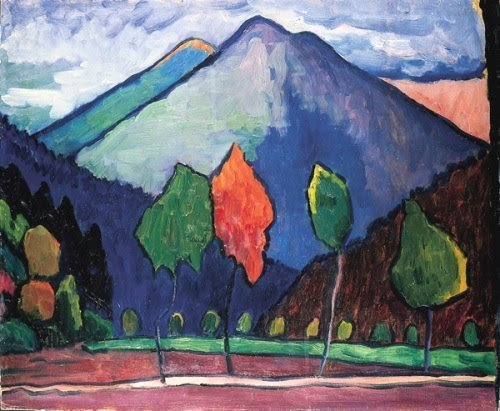
“After a short period of agony, I took a great leap forward from copying nature, in a more or less Impressionist style, to feeling the content of things.” ~ Gabriele Münter
Gabriele Münter is widely accepted as a fundamental German Expressionist painter, but many different movements influenced and helped progress her personal style. As the opening quote suggests, Münter embraced the freedom of emotional interpretation that became popular in the Modernist movement.
Born in Germany in 1877, Münter grew up during the rise of Impressionism and was shaped by the way in which the movement lacked the traditional conformity to shape and light. Impressionism grew out of the frustration with Salons’ and Academies insistence on carefully prescribed imagery. The use of paintings to depict realistic scenes for posterity was no longer the primary source for historic imagery after the advent of photography. Social and cultural developments encouraged people to question the status-quo; Impressionism became an example of the progressive times as it sought to capture the fleeting qualities of changing light on ordinary objects and modern scenes (Aste, 2017).
Münter’s early life gave her roots in the traditional studies of European Realism. Despite the conventions of her time, Münter’s parents encouraged their daughter’s interest in art; even allowing her a private tutor and enrollment in the Women’s Art School in Dusseldorf (Bachrach, 1981). Münter’s early sketches show her innate talent, but the young artist soon found herself uninspired by typical painting.
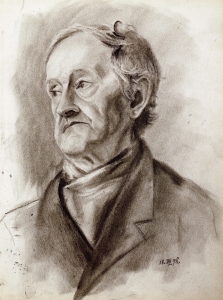
Münter enrolled in Phalanx, an unconventional art school, and quickly adapted to the Post-Impressionist style of painting popular at the time. Post-Impressionism incorporated the basic concepts of Impressionist interpretation and pushed the movement even further by going beyond the study of light’s effects and atmosphere to a more subjective form of representation (theartstory.com, n.d.). New painting theories began to develop as artists played with emotion, color, and shape on canvass; Münter’s strokes became bolder as her technique became more expressive.
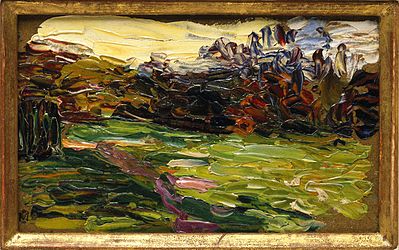
Phalanx would prove to be pivotal in Münter’s life as she began life-altering personal and professional relationships. The famed Expressionist painter Wassily Kandinsky was Münter’s teacher at the school and the two quickly began a personal relationship that would last the next twelve years. Münter traveled extensively during this time with Kandinsky and was able to explore different forms of modern painting. Münter created pieces with a pallet knife in 1908 after being taught by Kandinsky, her interest in the Post-Impressionist style continuing to influence her growth as an artist.
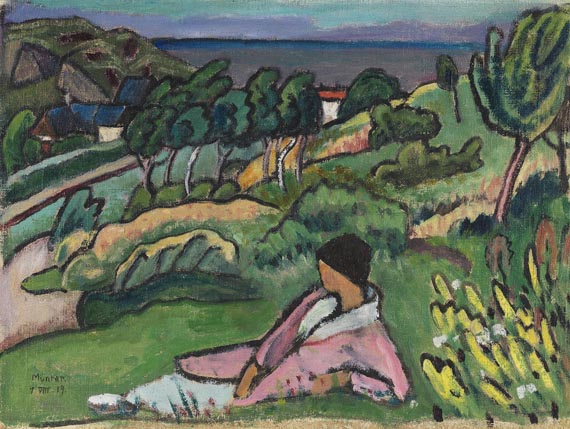
Münter gravitated towards the symbolic conveying of emotion through color and form, so much so that she and Kandinsky spent time in Paris studying the work of modernist artists’ like Matisse and Rousseau. Münter admired the energetic style of the Fauvists and the fluidity of their work. Derived from the French for ‘wild beasts,’ Fauvism described the quick and uninhibited way in which the artists composed paintings. The representational aspect of color was something that Fauvists manipulated so that the color itself could be an independent element of the canvass; saturated and unblended, it allowed tones to be emotional rather than actual (Aste, 2017). The time in France greatly expanded Münter’s artistic vision and her choice in color can be seen shifting to a more Expressionist style in works done after this time.
Münter explored Abstract Expressionism toward the end of her career, still enjoying the striking contrast of bold colors on a canvass. Aligning with the modern art movements of incorporating a range of emotional interpretation to artwork, Abstract Expressionism sought to show the effects of the subconscious in paintings through the use of archetypal symbols and contrasting colors (theartstory.org, n.d.). Abstract Expressionism embraced the avant-garde and while the movement incorporates many different styles like action painting and geometric abstracts, Münter did not stray from the latter. Just a few abstract paintings were completed, but the works meant that Münter never stopped developing her style; even into old age.
Münter is best known as a German Expressionist painter. Expressionism is often used to as an overarching theme to many of the sub-movements of the early twentieth century, but there are some solid definite aspects of expressionist paintings. Expressionism was about the artwork coming from the unique internal perspective of the artist, a true ‘expression’ of their interpretation of the world. Color was used to impress upon the viewer how the artists felt about a scene and distorted shapes helped to convey powerful personal messages like anxiety or passion (theartstory.org, n.d.).
Münter’s art shows a clear shift towards Expressionism throughout her career, but it was the evolution of the modern art world through the early twentieth century that led her to the style that made her feel complete. The expressive use of color and undulating lines of a moving perspective gave Münter satisfaction in work; not only is she an Expressionist painter, but she is widely considered one of the founding members of the movement in Germany. That great leap forward from copying nature to feeling a scene helped to solidify Münter as one of the greatest Expressionist artists of her time.
- Aste, R., & Small, L. (Eds.). (2017). French Moderns Monet to Matisse. New York, NY: Scala Arts.
- Bachrach, S. P. (191). A Comparison of the Early Landscapes of Munter and Kandinsky. Woman’s Art Journal, 2(Spring-Summer), 1st ser., 21-24.
- The Art Story. (n.d.). Abstract Expressionism Movement, Artists and Major Works. Retrieved from https://www.theartstory.org/movement-abstract-expressionism.htm
- The Art Story. (n.d.). Expressionism Movement, Artists and Major Works. Retrieved from https://www.theartstory.org/movement-expressionism.htm
- The Art Story. (n.d.). Post-Impressionism Movement, Artists and Major Works. Retrieved from https://www.theartstory.org/movement-post-impressionism.htm

 Express Yourself: The Art of Gabriele Münter