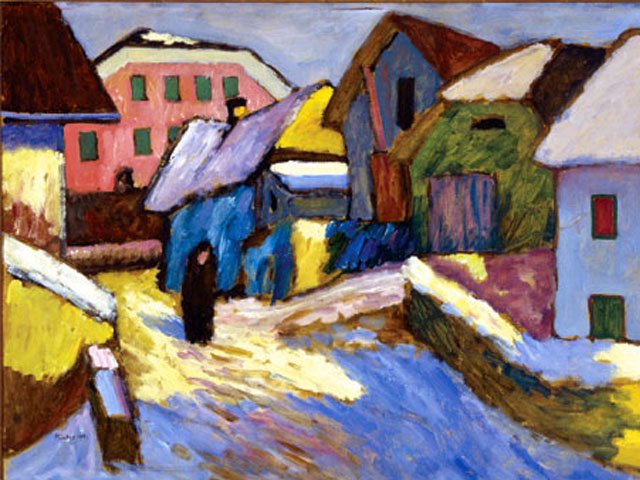
“It’s impossible to teach you anything. You can only do what’s grown inside you. Nature has given you everything you have.” ~ Wassily Kandinsky to Gabriele Münter
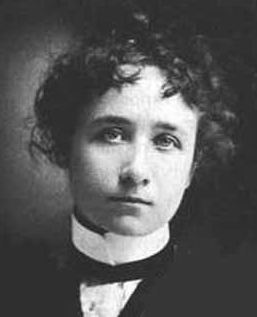
Gabriele Münter is widely accepted as a founding member of German Expressionism and an important figure in the progression of modern art movements; she unknowingly pushed the boundaries of traditional art interpretation to include the critical aspect of an artist’s emotional and symbolic representation.
Münter was born in Berlin, Germany on February 19, 1877 to an upper-middle class family (Bachrach, 1981). The young Münter studied the traditional elements of what would be considered a classical education for her time, piano and etiquette was a must, but she was drawn particularly to creating artwork. Her parents actively encouraged Münter’s artistic abilities and even had acquired a private tutor when she was in her teens (Bachrach, 1981). By the age of twenty, Münter had enrolled in the Women’s School of Art after studying briefly under Ernst Bosch in Düsseldorf, Germany.
Academic learning did not greatly appeal to Münter and after her parents died only a few years apart, she and her sister traveled to stay with family in the United States for an extended visiting 1898 (Gossman, 2017). Münter traveled through America from New York to Texas and whilst touring became prolific in photography. The sizable inheritance from her parents meant autonomy and that she could focus her talents where she wished, something that was difficult for women of her time because of traditional social conventions.
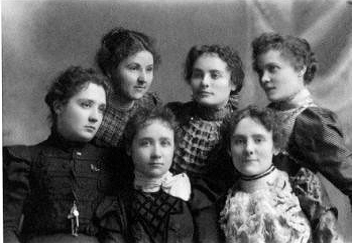
When returning to Germany in 1901, Münter continued to explore her unique freedom and enrolled in classes provided by the Munich Women Artists’ Association. Münter’s time in the school was short as she still did not much appreciate the conventional artistic styles taught, but she did study under known artists like Maximillian Dasio and Angelo Jank while in attendance (Bachrach, 1998). In 1902 Münter enrolled in yet another art school, Phalanx, run by founding member Wassily Kandinsky (wassilykandinsky.net, 2018). The modern approach to art intrigued Münter and the fact that they admitted women, a very progressive stance for the times, made the school a perfect fit for the young artist; the decision would prove to be pivotal in Münter’s life.
Münter thrived under Kandinsky’s tutelage and the two soon developed a personal relationship, pulled together by their mutual admiration for raw natural artistic talent and physical attraction. There was a problem, however, Kandinsky was married; the fact loomed over the entirety of their relationship. In terms of artistic development though, Münter and Kandinsky fed each other’s genius; both artists were very keen on furthering current art interpretation by imbuing works with the emotional and spiritual essence of the artist.
The pair traveled extensively throughout Europe and even visited North Africa in their quest for new artistic development (Bachrach, 1998). Münter learned a lot from Kandinsky during this time, but was also greatly influenced by the artistic styles she saw and studied. Münter was moved by the works she saw in Paris, Matisse’s Fauvist paintings in particular, and began incorporating bold expressive colors into her own style (Bachrach, 1981). The lovers continued to push the expressive qualities of painting and became founding members of two art groups, The New Artists’ Association of Munich and The Blue Rider.
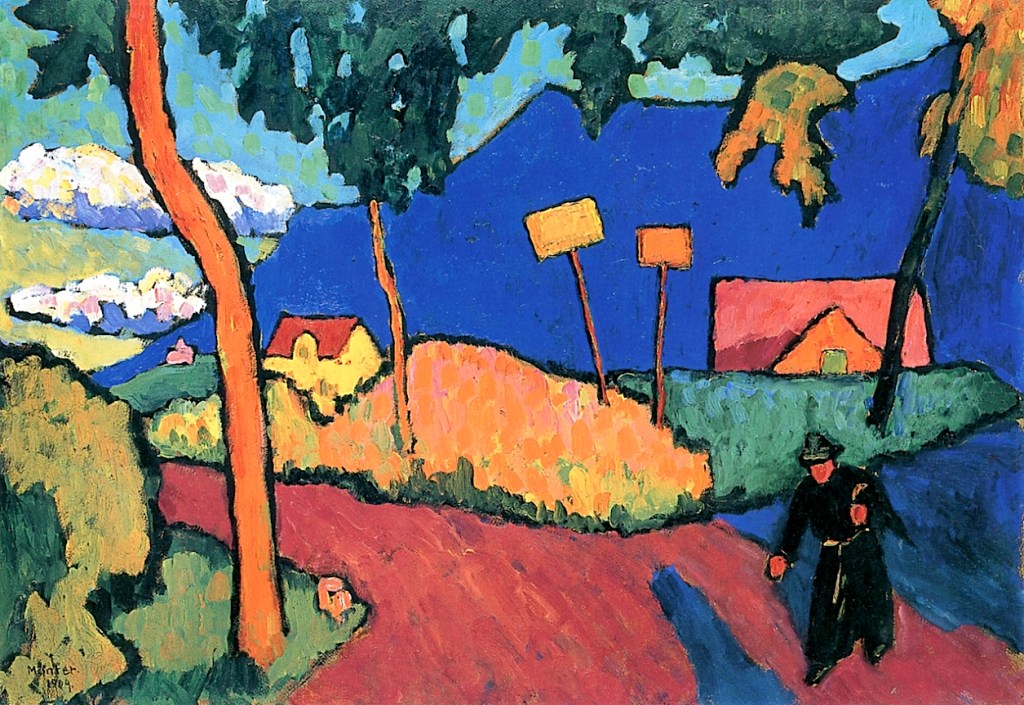
The New Artists’ Association of Munich was formed in response to the art-world’s stifling conventional approach to painting and when that group became too constrictive, Kandinsky and Münter left with a few others like Franz Marc to establish The Blue Rider (Koerner von Gustorf, n.d.). The newly created group focused on using colorfully symbolic imagery to express the inner thoughts and feelings of the creator. While only in existence for two years, The Blue Rider is credited with helping to bring about German Expressionism. New art theories were explored within the group and the few exhibitions they held opened society’s eyes to modern styles. The Bleu Rider ended in 1914, two years after it began, due to the outbreak of World War I; a moment again that would prove to be pivotal in Münter’s life.
With Germany declaring war on Russia in 1914, Münter’s Russian born lover Kandinsky became an enemy alien overnight; he had to leave Germany immediately. Münter and Kandinsky would see each other once more in the winter of 1915, but Münter did not know that would be the last time she was with her lover; Kandinsky stopped responding to her letters and did not speak to her again (wassilykandinsky.net, 2018). She did not know until 1921, when Kandinsky sent a lawyer for his pre-war artworks, that he had returned to Russia soon after their meeting and married another woman (P.W., 2013). The revelation devastated Münter as had his absence the previous years; she sued Kandinsky for damages due to his dishonesty and for storing his items throughout the war. Münter won over 1,000 artworks in her suit, but it did little to quell the hurt and anger she felt inside (P.W., 2013).
Münter subsequently went through a period during the early 1920’s where she produced very few artworks compared to her earlier robust period of creativity; her mourning took years to subside. It was after this time that Münter met the art historian Johannes Eichner, the two began living together in 1929 and Münter resumed the personal development she knew and loved (P.W., 2013).
Münter never stopped developing her own personal style and it was from artists like her that Expressionism was born. The drive to create scenes that depicted how the artist ‘felt’ the work radically changed the purpose of art; now works depicted what the artist wanted people to see emotionally not just representationally. Münter created abstract works later in her career, but never moved onto the style permanently. Without setting out to do it, Münter had helped establish the Expressionism style.
When the Second World War broke out, Münter brought all of the works she had collected over the years with Kandinsky and The Blue Rider and hid them in behind false walls in the basement of her house; she must have done it well because they were never found despite multiple home inspections (P.W., 2013). Her style was considered Degenerate Art and as such would have been destroyed by the Nazi regime if they had been found; many important pieces were saved by her forethought.
Münter continued to produce pieces as she and Eichner lived out the rest of their days in Murnau, Germany. On her eightieth birthday, Münter donated significant parts of her collection to the Städtische Gallery in Munich so that others would be able to study the works of early Expressionism (lenbachhaus.de, n.d.). Münter died, age 85, on May 19, 1962 in Murnau, Germany. In her will she set up the Gabriele Münter and Johannes Eichner Foundation which cares for her remaining artwork and her home in Murnau.
Gabriele Münter played a pivotal role in establishing the German Expressionist movement; she unknowingly pushed the boundaries of traditional art interpretation to include the critical aspect of an artist’s emotional and symbolic representation. The modern art world owes a lot to her determination and creativity.
- Bachrach, S. P. (1981). A Comparison of the Early Landscapes of Munter and Kandinsky. Woman’s Art Journal, 2(Spring-Summer), 1st ser., 21-24.
- Foundations. (n.d.). Retrieved from https://www.lenbachhaus.de/the-museum/foundations/muenter-eichner-foundation/?L=1
- Koerner von Gustorf, O. (n.d.). Profession: Woman Artist. Deutsche Bank Art Magazine. Retrieved from https://db-artmag.de/archiv/04/e/magazin-muenter.html
- Persons- Gabriele Münter. (2018). Retrieved from https://www.wassilykandinsky.net/gabrielemunter.php
- P.W. (2013). This is the house we used to live in. The Economist. Retrieved from https://www.economist.com/prospero/2013/05/24/this-is-the-house-we-used-to-live-in

 Express Yourself: The Art of Gabriele Münter